
When Can I Travel After Spinal Fusion Surgery?
Spinal fusion surgery is one of the more demanding procedures in orthopedic and neurosurgical care. It permanently joins two or more vertebrae together to eliminate painful movement, stabilize the spine, and give the bones a chance to heal as one solid structure. Because of how involved the healing process is, one of the first questions most patients ask their surgeon — often before they’ve even left the hospital — is simple: “When can I travel again?”
The honest answer is that it depends. Recovery from spinal fusion isn’t a fixed countdown clock; it’s shaped by the type of fusion you had, your age, your general health, and how your body responds to healing. That said, there are well-established general timelines that most surgeons follow, and understanding them can help you plan your next trip — whether it’s a short car ride to visit family or a long-haul flight overseas — without putting your recovery at risk.
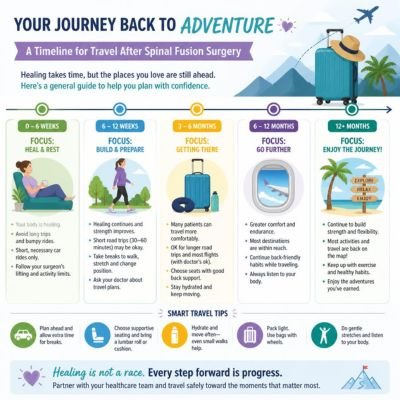
Most patients can expect to travel short distances within 2 to 4 weeks after spinal fusion surgery, provided they’re off strong pain medication and can sit comfortably. Longer trips, including road trips over a few hours and most air travel, are usually pushed back to 4 to 6 weeks, and in many cases surgeons prefer patients wait closer to 6 to 8 weeks for long-haul flights or international travel. Some surgeons are more conservative and recommend waiting a full 3 months, especially for multi-level fusions or cases involving significant hardware placement.
Why Travel Timing Matters So Much After Fusion Surgery
Spinal fusion isn’t like a typical soft-tissue surgery where you’re mostly waiting for a wound to close. The real healing happens deep inside the spine, where bone graft material needs time to grow and fuse the treated vertebrae into a single, stable unit. This biological process is slow. While skin and muscle tissue can heal in a matter of weeks, bone regeneration takes considerably longer — often three to six months for early fusion, and up to a year or more for the bone to become fully solid.
During this window, your spine is more vulnerable than usual. Prolonged sitting, awkward positioning, sudden jolts, and the physical stress of navigating airports, train stations, or long car rides can all place unwanted strain on a spine that’s still stabilizing. This is why the early travel restriction isn’t just about comfort — it’s about protecting the surgical outcome you worked hard to achieve.
There’s also a more immediate medical concern: blood clots. Any major surgery increases the risk of deep vein thrombosis (DVT), and that risk climbs when you combine surgical recovery with the kind of extended sitting that comes with travel. This is one of the main reasons surgeons are cautious about clearing patients for long trips too early.
A Week-by-Week Look at Travel Readiness
Week 1 to 2: Focus on Healing at Home
In the first two weeks, most patients are just settling into a home recovery routine. Walking short distances indoors is encouraged almost immediately — often within hours of surgery — because gentle movement supports circulation and helps prevent complications. But this is not the stage for travel. Pain is typically still significant, medication schedules are in flux, and the surgical site needs uninterrupted rest.
Short car rides to follow-up appointments are usually fine, especially if someone else is driving. Anything beyond that — a road trip, a flight, a long train journey — should wait.
Week 2 to 4: Local Travel Becomes More Realistic
By the two- to four-week mark, many patients notice a real shift. Pain is more manageable, walking distances increase, and some people are cleared to start driving short distances themselves, particularly if they’ve stopped taking opioid pain medication (driving while on narcotics is never advisable, regardless of how far along you are in recovery).
This stage is often when short local trips — visiting nearby family, attending a follow-up out of town, or a brief getaway close to home — start to become realistic, assuming your surgeon agrees your recovery is on track. Long car rides and flights are still generally discouraged during this window because of the extended sitting involved.

Week 4 to 6: The Turning Point for Longer Trips
This is typically when surgeons start giving the green light for longer journeys, including short-haul flights and multi-hour car trips. Many spine specialists consider four to six weeks a reasonable benchmark for moderate travel, assuming there are no complications and the patient is progressing well.
Even at this stage, though, travel isn’t something to approach casually. Long stretches of sitting still carry risk, and your spine — while sturdier than it was in week one — is still in an active healing phase. If you do travel during this period, planning frequent breaks to stand, stretch, and walk becomes essential.
Week 6 to 8 and Beyond: Long-Haul and International Travel
For long flights, cruises, or international trips, most surgeons recommend waiting at least six to eight weeks, and some prefer patients wait a full three months. Longer journeys mean longer periods of immobility, which raises the risk of blood clots and puts more cumulative strain on a spine that hasn’t fully fused yet. International travel adds another layer of complexity too: limited access to your own surgical team if something feels off, unfamiliar medical systems, and often much longer overall travel days once you factor in connections and ground transportation.
If a major trip is already on your calendar, it’s worth discussing the timing with your surgeon well before your surgery date, if possible, so you can plan realistically around your recovery rather than around the original itinerary.
Factors That Can Push Your Timeline Later
Not everyone follows the same curve. Several factors can extend how long you should wait before traveling:
Type and extent of the fusion. A single-level, minimally invasive fusion generally allows for a faster return to normal activity than a multi-level, open fusion involving significant hardware.
Nerve involvement. If your surgery involved decompressing or repositioning spinal nerves, recovery — and the travel timeline that comes with it — is often longer than for a straightforward stabilization procedure.
Age and overall health. Older patients, or those managing other health conditions, often heal more slowly and may need extra time before long trips are advisable.
Smoking and nicotine use. Nicotine restricts blood flow and interferes with bone growth, which can meaningfully slow down the fusion process and, by extension, delay safe travel.
How well you’re following restrictions. Patients who stick closely to their surgeon’s guidance on bending, lifting, and twisting during the early weeks tend to see steadier, more predictable progress than those who push through restrictions too soon.
Post-surgical complications. Infection, unexpected pain flare-ups, or slower-than-expected healing can all mean your travel clearance gets pushed further out than the general timeline suggests.
Practical Tips for Traveling Safely After Spinal Fusion
Once your surgeon has cleared you to travel, a few simple habits can make a real difference in how your body handles the trip:
- Move often. Whether you’re in a car or on a plane, aim to stand, stretch, or walk every 30 to 60 minutes. On flights, this might mean a short walk down the aisle; on road trips, it means building in regular rest stops.
- Support your spine. A small lumbar cushion can help maintain proper posture during long periods of sitting, whether you’re behind the wheel or in an airplane seat.
- Stay hydrated. Dehydration can increase stiffness and discomfort, and it may also raise clot risk during long trips.
- Wear compression stockings on longer journeys. These are commonly recommended for flights and long car rides to support circulation and reduce clot risk.
- Keep your pain management plan close at hand. Bring any prescribed medication with you, along with a copy of your surgical summary in case you need care while away from home.
- Know your airport security situation. Spinal hardware can occasionally trigger metal detectors. It’s worth carrying documentation of your surgery, though in practice most patients simply go through a secondary screening without any issues.
- Avoid heavy luggage. Lifting and carrying bags puts strain on a healing spine. Choose luggage with wheels, and ask for help with anything heavier than a few pounds.

When Can I Travel After Spinal Fusion Surgery?
When to Hold Off, Even If You’re “Cleared”
Even after you’ve technically reached the point in your recovery where travel is medically acceptable, there are situations where it still makes sense to wait a little longer:
- If you’re still experiencing significant, unmanaged pain
- If your incision hasn’t fully healed or shows any signs of infection
- If you’re still relying on strong pain medication that affects alertness or coordination
- If your surgeon has expressed any concern about how your fusion is progressing on recent imaging
Travel should never feel like something you’re gritting your teeth through. If a trip doesn’t feel manageable, it’s almost always better to delay than to risk a setback that extends your overall recovery.
Final Thoughts
There’s no single answer to “when can I travel after spinal fusion surgery” that applies to everyone. As a general guide, short local trips often become possible within two to four weeks, longer car rides and short flights are typically considered around the four-to-six-week mark, and long-haul or international travel is usually pushed to six to eight weeks or beyond — sometimes a full three months, depending on your specific procedure and recovery progress.
What matters most is listening to your body and following your surgeon’s individualized guidance rather than a generic timeline. Spinal fusion is a significant investment in your long-term spine health, and giving your body the time it needs to heal properly now means you’ll be able to travel — and enjoy it with far greater confidence later on.

Frequently Asked Questions
How soon after spinal fusion can I fly?
For short flights of two to three hours, many surgeons clear patients around the two- to four-week mark, provided pain is under control and there are no complications. Longer flights typically require waiting six to eight weeks, since extended sitting raises the risk of stiffness and blood clots.
Can I go on a road trip a few weeks after spinal fusion?
Short car rides are often fine within the first couple of weeks, especially as a passenger. For longer road trips lasting several hours, most surgeons recommend waiting until at least four to six weeks post-surgery, with frequent stops to stand and stretch along the way.
Is it safe to travel internationally after spinal fusion surgery?
International travel usually calls for a longer wait than domestic trips — often six to eight weeks at minimum, and sometimes closer to three months for more extensive fusions. The combination of long flight times, limited access to your regular surgical team, and unfamiliar medical systems makes extra caution worthwhile.
What happens if I travel too soon after spinal fusion?
Traveling before your spine is ready can increase the risk of complications such as blood clots, increased pain or swelling, and added strain on the healing fusion site. In more serious cases, it can interfere with how well the bone graft fuses, potentially affecting your long-term surgical outcome.
Will airport security detect my spinal hardware?
It’s possible. Metal screws, rods, or cages used in spinal fusion can sometimes trigger metal detectors. This isn’t usually a problem — most patients simply undergo a brief secondary screening. Carrying documentation of your surgery can help if questions come up.
How can I make a long flight or drive more comfortable after spinal fusion?
Getting up to walk or stretch every 30 to 60 minutes, using a lumbar support cushion, staying well hydrated, and wearing compression stockings on longer trips can all help reduce discomfort and lower the risk of blood clots during travel.
Do all spinal fusion patients follow the same travel timeline?
No. The right timeline depends on factors like the number of vertebrae fused, whether the procedure was minimally invasive or open, your age and general health, and how your individual recovery is progressing. Always confirm your specific timeline with your surgeon rather than relying on a general guideline.