
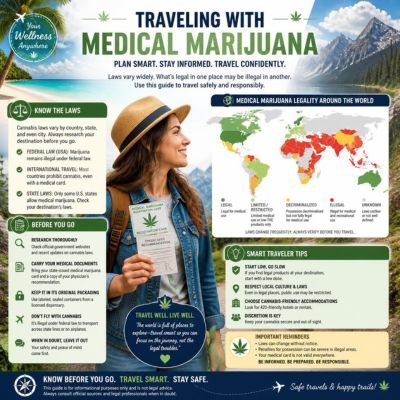
Can You Travel With Medical Marijuana?
Medical marijuana is now legal in some form in the majority of U.S. states, but that doesn’t automatically mean it’s safe or legal to travel with it. This is one of the most confusing areas of travel law in the country right now, and the confusion has only grown recently thanks to a partial federal rescheduling of cannabis and a quiet update to TSA’s own guidance. If you rely on medical cannabis and have a trip coming up, it’s worth understanding exactly where the law stands before you pack your bag.
The short version: traveling with medical marijuana is legally complicated, carries real risk depending on where you’re going, and a state medical card does not give you the protection many patients assume it does. Here’s what’s actually going on, broken down clearly.
As of now, marijuana — including medical marijuana — remains illegal under federal law in most circumstances, and air travel falls under federal jurisdiction. In April 2026, TSA updated its “What Can I Bring?” webpage to list medical marijuana as permitted in both carry-on and checked bags “with special instructions,” following a federal order that moved certain cannabis products from Schedule I to Schedule III.
However, TSA has publicly clarified that this update was a wording change only, not a shift in actual policy, and it has not issued any real guidance on quantities, documentation, or how officers should handle it. In practice, this means the legal gray area around flying with medical cannabis is murkier than ever, not clearer.
Traveling by car within a state where medical marijuana is legal is generally lower risk than flying, but crossing state lines by car — even between two states that both allow medical cannabis — is still technically a federal offense, since it involves transporting a controlled substance across a state border.
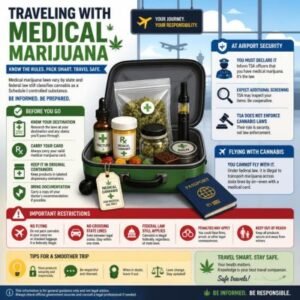
Why This Is So Complicated Right Now
For decades, the rule was simple, if frustrating: marijuana was a Schedule I controlled substance under federal law, full stop, and that included medical marijuana obtained legally under a state program. Airports and airplanes are federally regulated spaces, so state medical marijuana laws never applied there, no matter how legal your card was back home.
That changed slightly in the spring of 2026, when a federal rescheduling order moved two narrow categories of cannabis products from Schedule I to the less-restrictive Schedule III: FDA-approved cannabis-derived pharmaceuticals, and cannabis products obtained under a qualifying state medical marijuana license. Everything else — including any product from a recreational dispensary — legally stayed exactly where it was, in the same category as heroin.
Shortly after that order, TSA updated its website to reflect the change, listing medical marijuana as permitted with “special instructions” rather than flatly prohibited. But TSA has since gone on record saying its actual screening policy hasn’t changed, and that the update was made for “clarity and conciseness,” not to grant blanket permission.
No specific instructions about documentation, quantity limits, or product types have been published. In effect, the federal government has acknowledged medical cannabis exists as a distinct legal category, but it hasn’t built out any real framework for how that plays out at a security checkpoint.
What TSA Actually Does at the Checkpoint
It helps to understand what TSA officers are actually looking for. Their screening process is designed to catch security threats — weapons, explosives, and similar items — not to hunt for drugs. TSA has stated plainly that officers are not trained to search for marijuana or other illegal substances, and it isn’t part of their job to look for it.
That said, if cannabis is discovered during a routine bag check — for something entirely unrelated, like a laptop or liquid limit check — TSA’s policy is to refer the matter to a law enforcement officer, typically local airport police. What happens after that referral depends heavily on where you are:
- In states where cannabis, including medical cannabis, is legal, local law enforcement often has no real interest in pursuing the matter, and outcomes can range from simply being asked to dispose of the product to no action at all.
- In states where cannabis remains illegal, or where possession limits are stricter, the situation can escalate quickly, sometimes resulting in citations, confiscation, or even arrest, regardless of a valid medical card from another state.
- Airports can also have their own individual policies that differ from the surrounding state’s laws, adding yet another layer of unpredictability.
A state-issued medical marijuana card carries no legal weight at a TSA checkpoint or in federal airspace. It may, in some cases, help explain your situation to local law enforcement if a referral happens, but it does not override federal law and should never be assumed to guarantee protection.
Detection: What Actually Gets Cannabis Flagged
A common question patients have is how likely cannabis actually is to be detected while traveling. There are a few different ways this can happen, and understanding them helps set realistic expectations.
X-ray and CT scanners. Most major airports now use advanced CT scanners at security checkpoints, which create detailed 3D images of the contents of carry-on bags. These scanners are excellent at identifying organic matter and unusual shapes, meaning cannabis flower, edibles, or vape cartridges can show up clearly on screen even though the scanners weren’t specifically designed to look for them. Attempting to disguise cannabis products inside other containers is more likely to draw suspicion, not less, since it can visually resemble something more concerning.
Random or triggered bag searches. If your bag is pulled for a manual search — whether at random, because of an unrelated item, or because something looked unusual on the scanner — anything inside, including cannabis products, becomes visible to the officer conducting the search.
Checked baggage screening. Checked bags go through their own separate screening process, and TSA has explicit authority to open and inspect checked luggage without the passenger present if something is flagged. There’s no advantage to hiding cannabis in checked luggage instead of a carry-on; if anything, it removes your ability to explain the situation in the moment.
Drug-detection K-9 units. Many airports use trained dogs for broader security purposes, and some of these dogs are cross-trained to detect narcotics, including cannabis. Where and how often these units are deployed varies by airport.
Odor. This is a simple but common factor. Cannabis has a distinct smell that can be picked up by security personnel or even other passengers nearby, particularly with unsealed flower. Sealed, odor-proof packaging reduces this risk but doesn’t eliminate the legal issue if the product is discovered.
It’s worth noting that none of these detection methods are specifically hunting for cannabis. They exist for broader security purposes, and cannabis discovery is generally incidental rather than the goal. Still, “incidental” doesn’t mean “risk-free.”
International Travel Is a Different, Much Firmer Line
If domestic air travel with medical marijuana is a gray area, international travel is not. U.S. Customs and Border Protection (CBP) operates under federal law at every border crossing and port of entry, and federal law does not recognize state medical marijuana programs at all. CBP has the authority to seize cannabis products regardless of a valid state medical card, and doing so can carry serious consequences, including denial of entry, fines, or in more serious cases, referral for prosecution.
This applies both to leaving the U.S. with cannabis and to bringing it back in, even from a country or region where cannabis is legal. It also applies to non-U.S. citizens: admitting past or current marijuana use to a CBP officer, even in a place where it’s legal, has in some cases resulted in travelers being denied entry to the United States on the grounds of a controlled substance violation. Given the stakes, the safest approach for any international trip is to leave cannabis products behind entirely and, if needed, arrange to access medical cannabis or an alternative treatment at your destination.
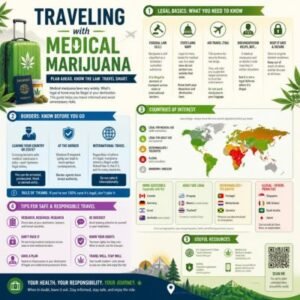
Practical Tips If You’re Traveling With Medical Marijuana Domestically
If you’ve weighed the risks and decide to travel with medical cannabis within the U.S., a few precautions can reduce — though never eliminate — your risk:
- Check the laws at both your departure and arrival locations, not just your home state, since legality and possession limits vary significantly.
- Stay within your state’s legal possession limits, and be aware that some airports enforce stricter rules than the surrounding state.
- Keep products in their original, labeled dispensary packaging rather than repackaging them, since this helps establish they came from a licensed source.
- Carry your medical marijuana card and any relevant physician documentation, even though it isn’t a legal guarantee, it can help clarify the situation if questioned.
- Avoid connecting through or landing in states with strict cannabis laws, even if your final destination is a legal state.
- Never bring cannabis products across an international border, in either direction, regardless of legality at either end.
- Consider sourcing medical cannabis at your destination instead, where reciprocity programs exist between certain states, rather than transporting it yourself.
The Bottom Line
Traveling with medical marijuana sits in a genuinely unsettled area of U.S. law. A 2026 shift moved some state-licensed medical cannabis products to a less restrictive federal category, and TSA’s public guidance now reflects that with a “special instructions” label, but the agency has been clear that its actual enforcement approach hasn’t changed and that no real framework exists yet. In practice, this means outcomes depend heavily on where you’re flying from, where you’re flying to, and which individual officers you encounter along the way. Traveling by car within a single legal state is comparatively lower risk, while international travel with cannabis of any kind remains a firm legal boundary that shouldn’t be crossed.
Until clearer federal guidance is issued, the safest approach for medical marijuana patients is to treat air travel and border crossings with real caution, understand the specific laws of every jurisdiction involved in your trip, and have a backup plan for accessing treatment at your destination when possible.
Frequently Asked Questions
Does TSA actively search for marijuana?
No. TSA’s screening process is designed to detect security threats like weapons and explosives, not drugs. However, if cannabis is discovered during a routine or random search for other reasons, officers are required to refer the matter to local law enforcement.
Can airport scanners detect marijuana?
Modern CT scanners used at many security checkpoints can identify organic material and unusual shapes in carry-on bags, which means cannabis products can become visible on screen even though the scanners weren’t built specifically to find them. Manual bag searches and drug-detection K-9 units at some airports can also lead to discovery.
Does a medical marijuana card protect me at the airport?
Not fully. A state-issued medical card has no legal authority in federal airspace or at a TSA checkpoint, since federal law governs air travel. It may help explain your situation if local law enforcement gets involved, but it doesn’t guarantee protection from confiscation or legal consequences.
Is it safer to fly with medical marijuana between two states where it’s legal?
It carries somewhat lower practical risk than flying to or through a state where cannabis remains illegal, but it’s still not risk-free. Crossing state lines with cannabis, even between two legal states, remains a federal offense, and individual airports can have their own stricter local policies.
Can I bring medical marijuana on an international flight?
No. Cannabis should never be carried across an international border in either direction. U.S. Customs and Border Protection enforces federal law, which doesn’t recognize state medical marijuana programs, and international destinations have their own separate laws that may be far stricter.
What happens if TSA finds medical marijuana in my bag?
TSA itself does not have authority to make arrests or press charges. If cannabis is found, the matter is referred to local law enforcement, and the outcome depends entirely on that jurisdiction’s laws, ranging from no action in some legal states to citations or arrest in states where cannabis remains illegal.
Is it legal to drive with medical marijuana within my own state?
Generally, yes, if you stay within your state’s legal possession limits and follow its specific rules for medical patients, such as keeping products in original packaging. Driving is regulated primarily by state law, unlike air travel, which falls under federal jurisdiction.
Just signed up last week and I am already hooked. The welcome bonus actually showed up in my account without any tricky steps. Payments are secure and I like that I can set my own deposit limits to keep things fun and balanced.
67899bet’s a good way to scratch that itch! They offer a wide array of options to win. It’s pretty intuitive to navigate I’ve found, and the customer service is relatively quick to respond. Give it a shot! 67899bet