
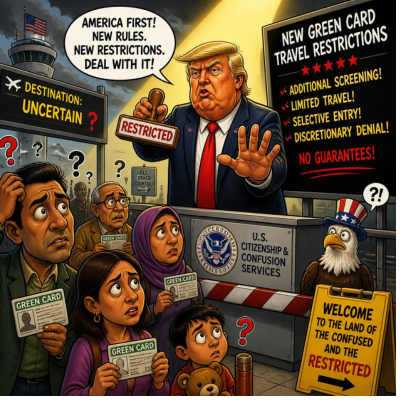
Trump Green Card Travel Restrictions
If you’re a green card holder trying to figure out whether it’s safe to travel internationally right now, you’re not alone, and the confusion is understandable. Immigration policy has shifted substantially since early 2025, with an expanded travel ban, new biometric screening requirements, and a Supreme Court ruling that gave border officers considerably more discretion over returning permanent residents.
The core legal fact hasn’t changed — green card holders are still technically exempt from the travel ban itself — but “exempt” and “unaffected” have turned out to be two very different things in practice. Here’s a clear, current breakdown of where things actually stand for green card holders heading into international travel in 2026.
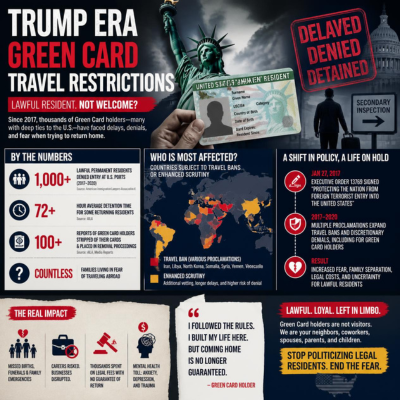
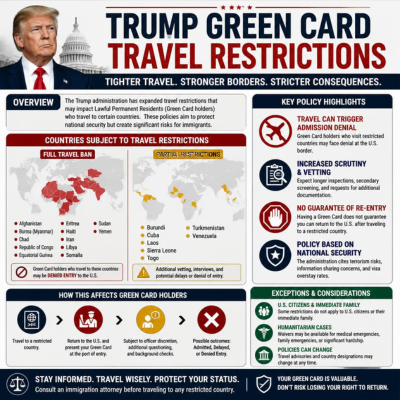
Lawful permanent residents remain formally exempt from the travel ban proclamations issued under the current administration, which now cover nationals of 39 countries in some form as of January 1, 2026. This means a valid green card holder generally cannot be denied entry to the U.S. purely because of their country of origin.
However, green card holders now face substantially more scrutiny at the border than they did in past years, including mandatory biometric screening, closer review of criminal history and past visa violations, and in some documented cases, pressure to sign away their status voluntarily. The safest approach for 2026 depends heavily on your individual circumstances — particularly your country of origin, any past criminal record, and how long you plan to be outside the U.S.
The Expanded Travel Ban and What It Actually Means for Green Card Holders
On December 16, 2025, the administration issued a revised and significantly expanded travel ban proclamation, effective January 1, 2026, that fully or partially restricts entry for nationals of 39 countries, along with anyone traveling on Palestinian Authority-issued travel documents.
This built on an earlier June 2025 proclamation that had targeted 19 countries, adding countries including Burkina Faso, Mali, Niger, South Sudan, Syria, Laos, and Sierra Leone, among others, while also expanding partial restrictions to 15 additional nations.
The proclamation is explicit that lawful permanent residents are exempt from these restrictions. If you already hold a valid green card, the travel ban itself does not bar you from re-entering the United States, regardless of which country you’re a national of. This exemption also generally extends to dual nationals traveling on a passport from a country not on the restricted list.
That said, the exemption applies to the ban itself, not to the broader immigration enforcement environment green card holders now find themselves navigating. Multiple sources have reported that green card holders from the originally restricted countries are facing intensive review of their existing status, and that immigrant visa processing has been paused entirely for people from a much larger list of 75 countries, which affects family members still trying to join green card holders already in the U.S.
Heightened Scrutiny: What’s Actually Changed at the Border
This is where the practical impact on green card holders has grown the most. Several enforcement changes now apply broadly to all green card holders, not just those from restricted countries:
Mandatory biometric screening. As of late December 2025, Customs and Border Protection can now collect facial recognition data from all noncitizens entering and exiting the U.S., including green card holders, at airports, land crossings, and seaports. This is a broader requirement than what existed previously, and it applies regardless of destination or country of origin.
Criminal history review. Immigration officers are now directed to review the criminal records of returning green card holders more closely than before, and reports indicate this includes flagging even minor past issues, such as an old marijuana-related charge, a dismissed case, or an arrest that never led to a conviction. A landmark Supreme Court ruling in June 2026 gave CBP the authority to treat any returning green card holder as “seeking admission” without needing a prior legal exception to do so, which significantly broadens the situations in which a green card holder’s status can be questioned upon return.
Social media and political activity vetting. Advocacy organizations have reported that the administration has directed scrutiny not just toward criminal history but toward green card holders’ social media activity and participation in protests or political expression the administration considers objectionable, characterizing certain activity as a potential national security concern.
Pressure to sign Form I-407. There have been documented reports of green card holders being pressured by border officers to voluntarily sign Form I-407, which formally abandons permanent resident status. This is not something a green card holder is required to sign, and legal advocates strongly recommend refusing to sign anything at the border without first speaking to an immigration attorney, and requesting a supervisor if pressure continues.
Who Faces the Highest Risk When Traveling
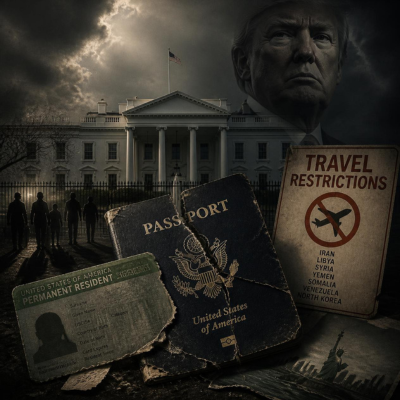
Based on current guidance from immigration attorneys and advocacy groups, a few categories of green card holders face meaningfully elevated risk when traveling internationally right now:
Anyone with a past criminal record, even a minor or resolved one. This includes convictions, but also pending charges, dismissed cases, or old arrests that never resulted in a conviction. Because criminal court outcomes and immigration consequences are evaluated under different legal standards, a plea deal or reduced charge that seemed fully resolved years ago doesn’t necessarily protect someone at the border anymore.
Green card holders from originally restricted countries. While the travel ban doesn’t apply to them directly, reports indicate that USCIS has been reviewing the immigration status of green card holders from the countries originally covered by the June 2025 proclamation, which raises the stakes of any international travel for this group specifically.
Anyone who has spent more than 180 continuous days outside the U.S. Extended absences have always carried some risk of being questioned about intent to maintain residency, but this scrutiny has intensified considerably under the current enforcement posture.
People with any pending immigration paperwork. Green card holders in the process of removing conditions on a marriage-based card, renewing documents, or with any other application pending at USCIS should be especially cautious, given that processing timelines have lengthened and travel during a pending case can complicate matters further.
Individuals who have engaged in public political expression the administration has flagged as objectionable. Advocacy groups have specifically warned that participation in protests or certain public statements could trigger additional scrutiny, separate from any criminal or immigration violation.
What About Green Card Applicants Still in Process?
Beyond travel restrictions for existing green card holders, the administration announced a major policy shift in May 2026 that changes how people currently in the U.S. can even become green card holders in the first place. Under this new guidance, most people applying for a green card while already in the U.S. on a temporary visa are now expected to return to their home country and complete the process through consular processing abroad, rather than adjusting their status without leaving the country, which had been standard practice for decades.
This creates a serious complication for applicants from countries currently subject to travel restrictions or paused visa processing, since returning home to complete an application could mean being unable to come back at all. If you’re in this situation, it’s worth discussing your specific case with an immigration attorney before making any decisions about travel or applying for adjustment of status.
Practical Steps for Green Card Holders Planning to Travel
Given the current environment, immigration attorneys and advocacy organizations are generally recommending a more cautious approach than in past years:
- Consult an immigration attorney before traveling if you have any criminal history, no matter how old, minor, or seemingly resolved. This is now considered essential rather than optional for this group.
- Carry thorough documentation of your U.S. ties, including proof of employment, a lease or mortgage, tax filings, and family connections, in case you’re questioned about your intent to maintain residency.
- Keep your green card, and any relevant USCIS receipt notices, easily accessible when traveling, along with a valid passport from your country of citizenship.
- Never sign Form I-407 at the border without speaking to an attorney first. You have the right to decline and to request a supervisor if you feel pressured.
- Be mindful of what’s visible on your social media accounts, given reports that political expression and activism are being factored into enforcement decisions.
- Avoid extended absences of six months or more when possible, and apply for a reentry permit in advance if a longer trip is unavoidable.
- Check current country-specific restrictions before booking travel, since the list of affected countries has changed multiple times and could change again.
- Keep your attorney’s contact information on hand while traveling, in case a situation arises at the port of entry that requires immediate legal guidance.
The Bottom Line
Green card holders remain legally exempt from the travel ban itself, and that fundamental protection hasn’t changed. What has changed substantially is the enforcement environment surrounding that exemption — expanded biometric screening, closer scrutiny of criminal history and past visa violations, reported monitoring of political activity, and a Supreme Court ruling that gives border officers considerably more room to question returning residents than in previous years.
For most green card holders with no criminal history, no pending immigration issues, and a straightforward travel itinerary, international trips generally continue without major incident. But given how quickly this landscape has shifted through 2025 and 2026, and how much individual risk can vary,
checking in with an immigration attorney before travel — especially for anyone with a criminal record, pending paperwork, or ties to a restricted country — is no longer just a precaution, it’s become standard advice from the legal community.
Frequently Asked Questions
Are green card holders affected by the current travel ban?
No, not directly. Lawful permanent residents are explicitly exempt from the travel ban proclamations, including the expanded version effective January 1, 2026, which covers 39 countries. A valid green card holder cannot be denied entry solely based on their country of origin under this policy.
Can a green card holder be detained when returning to the U.S.?
Yes, in certain circumstances. Reports indicate that green card holders, particularly those with any past criminal history, have been stopped, questioned, and in some cases detained upon return, following a 2026 Supreme Court ruling that expanded CBP’s authority to treat returning residents as seeking admission.
Should I sign Form I-407 if a border officer asks me to?
No, not without speaking to an immigration attorney first. Form I-407 is a voluntary abandonment of permanent resident status, and signing it can permanently end your green card. You have the right to decline and to request a supervisor if you feel pressured.
Does having an old, dismissed criminal charge put me at risk when traveling?
It can. Immigration consequences are evaluated under different standards than criminal court outcomes, meaning even a dismissed case, an old arrest without conviction, or a reduced charge from years ago may no longer offer the protection it once did. Consulting an attorney before traveling is strongly recommended if this applies to you.
Do green card holders now face biometric screening when traveling?
Yes. As of late December 2025, Customs and Border Protection can collect facial recognition data from all noncitizens, including green card holders, at every entry and exit point, including airports, land crossings, and seaports.
Can I still adjust my status to a green card while staying in the U.S.?
In most cases, no, as of a May 2026 policy change. People currently on temporary visas seeking a green card are now generally required to return to their home country and complete the process through consular processing abroad, rather than adjusting status without leaving the U.S.
What should I do before traveling if I’m a green card holder from a restricted country?
Speak with an immigration attorney before booking any international travel. While the travel ban doesn’t apply to you directly as a green card holder, reports indicate that USCIS is reviewing the status of green card holders from originally restricted countries, which raises the stakes of any trip abroad.