
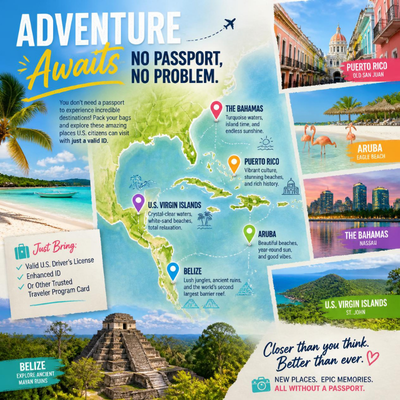
Where Can Americans Travel Without a Passport?
Not having a passport doesn’t have to mean canceling your travel plans. Whether yours expired, got lost, is stuck in processing, or you simply never got around to applying for one, there’s still a genuinely surprising number of places U.S. citizens can visit using nothing more than a government-issued photo ID.
These aren’t consolation-prize destinations either — we’re talking about tropical beaches, rainforests, historic old towns, and island culture that feels a world away from home, even though technically you never left U.S. jurisdiction.
Here’s a complete, up-to-date breakdown of where Americans can travel passport-free, what ID you actually need, and the details that trip people up most often.
U.S. citizens can travel without a passport to any U.S. state, plus several U.S. territories, since travel between them is legally treated as domestic travel rather than international travel. The main passport-free territories are Puerto Rico, the U.S. Virgin Islands, Guam, and the Northern Mariana Islands.
Beyond U.S. territories, closed-loop cruises — ones that depart and return to the same U.S. port — allow passport-free travel to a number of Caribbean and nearby international destinations, provided you have a government-issued photo ID and, in most cases, a certified birth certificate.
Since May 2025, the REAL ID Act has been fully enforced, which means that for any of this to work by air, your driver’s license or state ID needs to be REAL ID-compliant, or you’ll need another TSA-accepted form of identification instead.
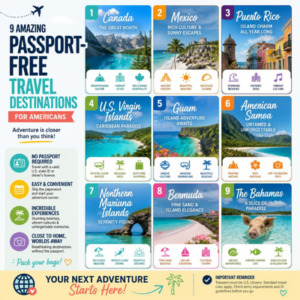
U.S. Territories: The Simplest Passport-Free Option
Because these locations are U.S. territories, flying or sailing to them from the U.S. mainland is treated exactly like flying between two states — no customs, no immigration checkpoint, no passport stamp.
Puerto Rico
Puerto Rico is by far the most popular and accessible option, with frequent direct flights from major cities on the East Coast, often in the range of two and a half to four hours. San Juan offers colorful colonial architecture and historic forts, while El Yunque National Forest gives you lush rainforest hiking without ever leaving U.S. jurisdiction. All that’s required is a REAL ID-compliant driver’s license or state photo ID.
U.S. Virgin Islands
St. Thomas, St. John, and St. Croix make up the U.S. Virgin Islands, and all three offer the kind of turquoise water and white sand you’d expect from a much more complicated international trip. St. John in particular is largely protected as national parkland, covering roughly 60% of the island, and the islands use the U.S. dollar just like the mainland. A REAL ID-compliant ID is all you need here as well.
Guam
Out in the western Pacific, Guam is a U.S. territory that blends beaches, volcanic scenery, and deep cultural history, including sites connected to World War II. Because Guam is so far from the mainland, most direct routes connect through Honolulu, and U.S. citizens 18 and older can generally enter with a REAL ID or valid government-issued photo ID, sometimes alongside a copy of a birth certificate depending on the specific carrier or entry point.
Northern Mariana Islands
Just north of Guam, the Northern Mariana Islands — a self-governing commonwealth affiliated with the U.S. — include Saipan, Tinian, and Rota. These islands feature volcanic peaks, coral reefs, and a much quieter, less touristy feel than some other Pacific destinations, and the same passport-free rules apply for U.S. citizens.
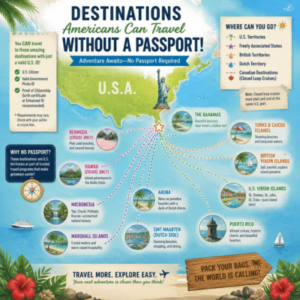
American Samoa: The Exception Worth Knowing About
American Samoa is technically a U.S. territory, but it’s the outlier on this list. According to official U.S. government guidance, American Samoa actually does require a passport or a certified U.S. birth certificate to enter, unlike the other territories mentioned above.
This trips a lot of travelers up, since American Samoa gets lumped in with “passport-free” territories in a lot of casual travel advice. If American Samoa is on your radar, double-check current entry requirements directly, since the rules here genuinely differ from Puerto Rico, Guam, and the U.S. Virgin Islands.
Closed-Loop Cruises: A Different Kind of Passport-Free Travel
If you’d rather see multiple destinations on one trip, a closed-loop cruise is one of the most practical passport-free options available to U.S. citizens. A closed-loop cruise is one that departs from a U.S. port and returns to that same U.S. port, without any international flights involved in getting to or from the ship.
On these cruises, U.S. citizens are generally permitted to travel with just a government-issued photo ID and, in many cases, a certified birth certificate, rather than a full passport, even though the ship visits countries like Mexico, various Caribbean nations, or parts of Central America along the way. This works because, technically, you’re departing and returning to the same country, and cruise lines have specific documentation arrangements in place with the countries on their itineraries.
There’s an important catch here, though: the moment your itinerary includes even a single stop in a country that specifically requires a passport for entry, that requirement applies to the entire cruise. A handful of Caribbean destinations — including countries like Barbados, Trinidad and Tobago, and a few others depending on the season and specific itinerary — do require a passport, and if your cruise touches even one of those, you’ll need one for the whole trip, not just that particular stop.
Because of this, and because of the practical risk of a travel emergency, most travel experts strongly recommend bringing a passport on a closed-loop cruise even when it’s technically not required. If you ever needed to leave the ship early and fly home internationally, for a medical emergency or any other reason, you’d need a passport to do it, and not having one in that scenario can turn a bad situation into a much worse one.
What About the Passport Card?
If you don’t want to deal with the cost or wait time of a full passport book, the U.S. passport card is a cheaper, wallet-sized alternative that some travelers aren’t fully aware exists. It’s important to understand its real limitations, though: the passport card is only valid for land and sea border crossings, primarily to Canada, Mexico, and the Caribbean, plus Bermuda. It cannot be used for international air travel under any circumstances. If your travel plans involve flying internationally, even to a nearby destination, the passport card won’t work, and you’ll need the full passport book instead.
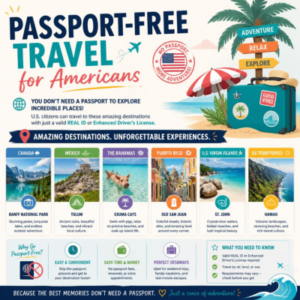
REAL ID: What It Actually Covers
It’s worth clarifying what REAL ID does and doesn’t do, since it’s frequently confused with passport requirements. A REAL ID-compliant driver’s license or state ID satisfies TSA’s identification requirements for domestic flights, which now includes flights to passport-free U.S. territories like Puerto Rico and Guam, since those are treated as domestic travel.
However, REAL ID is not a substitute for a passport when it comes to genuinely international travel or re-entering the U.S. from outside the country. A full U.S. passport book (or in limited cases, a passport card) automatically satisfies REAL ID requirements too, so if you already have a valid passport, you’re covered either way.
If you show up at airport security without a REAL ID-compliant ID and without a passport, you’re not automatically turned away, but you may be routed through TSA’s identity verification process, which can involve delays, additional questioning, and in some cases a fee, with no guarantee that your identity can be confirmed in time for your flight.
Practical Tips for Passport-Free Travel
- Confirm your ID is REAL ID-compliant before booking. Most state driver’s licenses issued in recent years already meet the standard, but it’s worth checking, especially if your ID hasn’t been renewed recently. Look for a star marking in the corner of your license as one common indicator.
- Bring a certified birth certificate as backup, particularly for territories like Guam or for closed-loop cruises, where it’s sometimes requested alongside your photo ID.
- Double-check American Samoa separately if it’s part of your plans, since its entry requirements differ from the other passport-free territories.
- Research your specific cruise itinerary closely if you’re considering a closed-loop cruise, since a single passport-required port of call changes the documentation needed for the entire trip.
- Consider bringing a passport anyway on cruises, even when not required, as a safety net in case of an emergency that requires flying home internationally mid-trip.
- Check your travel insurance and health coverage, since standard domestic health insurance may not fully apply once you’re technically outside the continental U.S., even in a passport-free territory.
- Apply for a passport now if you think you’ll need one soon anyway. Even if your current trip doesn’t require one, passport processing times can run long, and having one on file gives you far more flexibility for future travel.
Final Thoughts
Not having a passport doesn’t mean your travel options are limited to your own state. Puerto Rico, the U.S. Virgin Islands, Guam, and the Northern Mariana Islands all offer full tropical or island getaways using nothing more than a REAL ID-compliant photo ID, since travel to and from these territories is legally treated as domestic.
Closed-loop cruises open up an even wider range of international-feeling destinations, though the passport-free status depends entirely on your specific itinerary. Just remember that American Samoa is the one territory that doesn’t follow the same passport-free rule as the others, and that a passport card, while useful for land and sea travel, won’t help you board an international flight.
Frequently Asked Questions
Can I fly to Puerto Rico without a passport?
Yes. Puerto Rico is a U.S. territory, so travel there from the U.S. mainland is treated as domestic travel. A REAL ID-compliant driver’s license or state-issued ID is sufficient for U.S. citizens.
Do I need a passport for a Caribbean cruise?
Not necessarily, if it’s a closed-loop cruise that departs from and returns to the same U.S. port without visiting a country that specifically requires a passport. A government-issued photo ID and, often, a certified birth certificate are usually sufficient in that case, though many travelers still choose to bring a passport as a precaution.
Is American Samoa passport-free like other U.S. territories?
No. Unlike Puerto Rico, Guam, the U.S. Virgin Islands, and the Northern Mariana Islands, American Samoa requires a passport or a certified U.S. birth certificate for entry, according to official U.S. government guidance.
Can I use a passport card instead of a passport book for international flights?
No. The U.S. passport card is only valid for land and sea border crossings to destinations like Canada, Mexico, and parts of the Caribbean and Bermuda. It cannot be used to board an international flight under any circumstances.
What happens if my ID isn’t REAL ID-compliant and I don’t have a passport?
You likely won’t be turned away outright, but you may be sent through TSA’s identity verification process, which can involve extra screening, delays, and sometimes a fee, with no guarantee your identity will be confirmed in time to make your flight.
Do children need ID or a passport to fly domestically to a U.S. territory?
Generally, children under 18 do not need to present ID for domestic flights within the U.S., which includes flights to passport-free territories like Puerto Rico and Guam. It’s still a good idea to check with your specific airline for any age-related documentation requirements.
Is Guam considered domestic or international travel for U.S. citizens?
Domestic. Guam is a U.S. territory, so flights there from the U.S. mainland don’t require a passport for U.S. citizens, though many travelers connect through Honolulu due to limited direct routes.
This article is for general informational purposes only. Entry requirements and REAL ID enforcement can change, so always verify current rules with TSA, USAGov, or your specific airline or cruise line before traveling.
Signing up felt like the simplest puzzle I have solved all week. The welcome package hits exactly how I hoped and the rules are written in plain language instead of confusing legal jargon. I love how the promotions change just enough to keep things fresh without feeling forced. My bankroll has never been happier after joining this community. Jump in today coolbetregistrarse