
Travel & Cycle Toolkit
Predict how your trip will throw off your body clock
Three quick calculators — a period delay estimator, a jet lag recovery timer, and a cycle tracker — built for anyone wondering what a trip is about to do to their schedule.
Period Delay Predictor
Estimate how much your upcoming trip might push your period back, based on time zone shift, trip length, and how disruptive the trip will likely be.
Estimated outcome
Expect your period 2–5 days late
—
Originally expected
—
Revised window
—
These calculators give general, educational estimates only — they aren't a diagnosis and don't account for individual medical conditions, medications, or irregular cycles. If your period is very late, absent, or accompanied by symptoms that concern you, please check in with a doctor or gynecologist.
Predict how your trip will throw off your body clock
Three quick calculators — a period delay estimator, a jet lag recovery timer, and a cycle tracker — built for anyone wondering what a trip is about to do to their schedule.
Estimate how much your upcoming trip might push your period back, based on time zone shift, trip length, and how disruptive the trip will likely be.
Can Traveling Delay Your Period?
This article is for general informational purposes only and isn’t a substitute for advice from a doctor or gynecologist. If your period is very late, unusually painful, or accompanied by other symptoms, please check in with a healthcare provider.
You booked the trip, packed your bags, crossed a few time zones — and now your period is nowhere to be seen. If you’re wondering whether traveling really can throw off your cycle, the short answer is yes, it can. Your menstrual cycle is controlled by a finely tuned hormonal system, and that system is surprisingly sensitive to changes in sleep, stress, light exposure, and routine — all things that happen the moment you step off a plane in a new place.
Below, we’ll walk through exactly why travel messes with your cycle, how long a travel-related delay usually lasts, and when a late period might be about something other than your trip.
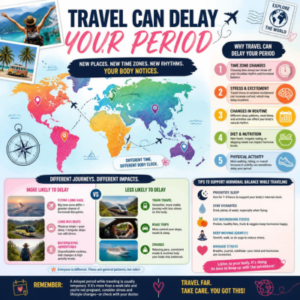
Can Traveling Really Delay Your Period?
Yes. Your menstrual cycle is regulated by the hypothalamic-pituitary-ovarian (HPO) axis — a communication loop between your brain and your ovaries that releases the hormones responsible for ovulation and, eventually, your period. The hypothalamus, which kicks off this whole process, is also deeply connected to your body’s stress response and internal clock. When travel disrupts either of those, the hormonal signals that trigger your period can be delayed, sometimes by several days to over a week.
This isn’t a rare fluke either. Many frequent travelers, flight attendants, and anyone who’s taken a long international trip report the same pattern: cycles that arrive late, feel different, or are heavier or lighter than usual after a big trip.
Why Does Travel Affect Your Menstrual Cycle?
There isn’t just one culprit — it’s usually a mix of several travel-related changes hitting your body at once.
1. Jet Lag and Circadian Disruption
Your body runs on an internal clock, called your circadian rhythm, that governs everything from when you feel sleepy to when certain hormones get released. Crossing multiple time zones throws that clock out of sync with the actual time at your destination — commonly known as jet lag. Because your circadian rhythm and your reproductive hormones are closely linked through the hypothalamus, a disrupted body clock can delay the hormonal cascade that triggers menstruation. Generally, the more time zones you cross, and the more eastward the direction (which shortens your day), the harder your body has to work to catch up.
2. Travel-Related Stress
Even a “fun” trip is stressful on the body. Rushing to the airport, navigating security, worrying about missed connections, sleeping in an unfamiliar bed, or simply being out of your normal routine all raise cortisol, your primary stress hormone. Elevated cortisol can suppress the release of gonadotropin-releasing hormone (GnRH), the signal that kicks off ovulation. No ovulation signal, or a delayed one, means your period shows up later than expected.
3. Changes in Sleep Patterns
Between early flights, late check-ins, and adjusting to a new time zone, sleep is often the first thing to suffer while traveling. Poor or irregular sleep affects the same hormonal pathway as stress and jet lag, since melatonin (your sleep hormone) and reproductive hormones interact more than most people realize. A few nights of broken sleep usually won’t do much, but a week or more of disrupted rest can genuinely shift your cycle.
4. Physical Exertion
Long days of sightseeing, hiking, or an especially active itinerary can be a bigger physical load than your body is used to. Sudden increases in physical activity are a known trigger for delayed or missed periods, especially if they’re paired with less food intake or dehydration, both of which are common when you’re busy exploring instead of sticking to your normal eating schedule.
5. Diet and Hydration Changes
Trying new foods, eating on irregular schedules, or simply drinking less water than usual (easy to do on a long flight) can all affect your body’s hormone balance in small but real ways. Sudden weight fluctuations, even minor ones, can also be enough to nudge ovulation timing.
6. Altitude
If your travels take you somewhere with a significant change in altitude, that’s worth factoring in too. Higher altitudes mean lower oxygen levels, which places additional physiological stress on the body and has been associated with menstrual irregularities in some travelers, especially on longer stays at elevation.

How Long Can a Travel-Related Period Delay Last?
For most people, a travel-related delay is temporary — typically anywhere from a few days to about one to two weeks. Once your sleep schedule, stress levels, and routine settle back to normal (usually within a week or so of returning home), your cycle tends to follow shortly after.
That said, everyone’s body responds differently. Some people notice no change at all after a trip, while others experience a delay after even a short domestic flight if the trip happened to line up with a stressful or exhausting stretch. The length of the trip, number of time zones crossed, and how disruptive it was to your normal routine all play a role in how long the delay lasts.
Can a Short Trip Delay Your Period, or Does It Only Happen on Long Trips?
It’s not only about distance. A short but high-stress trip — a work conference with early mornings and late dinners, for example — can delay your period just as easily as a two-week international vacation. What matters most is how much the trip disrupts your normal sleep, stress levels, and routine, not simply how many miles you traveled.
Does Travel Affect Period Symptoms Too?
Many people notice more than just a delay. It’s common to experience:
- Heavier or lighter flow than usual
- More intense cramps
- Increased PMS symptoms like mood swings or bloating
- A shorter or longer cycle length the following month
These changes are generally linked to the same hormonal disruption causing the delay itself, and they usually resolve within a cycle or two once your body settles back into its normal rhythm.

Tips to Minimize Period Disruption While Traveling
You can’t fully control your hormones, but a few habits can soften the impact of travel on your cycle:
- Try to stick to a sleep schedule. Where possible, keep consistent sleep and wake times, and use tools like an eye mask or blackout curtains to help your body adjust to a new time zone faster.
- Stay hydrated. Cabin air and long travel days are dehydrating; drink more water than you think you need.
- Eat on a semi-regular schedule. Skipping meals or going long stretches without food can add extra stress to your system.
- Build in downtime. Packing every hour of a trip with activities sounds fun in theory but can leave your body running on empty.
- Pack period supplies regardless of timing. Since travel can make your cycle unpredictable, it’s worth having supplies on hand even if your period “isn’t due” according to your usual schedule.
- Consider your birth control timing. If you’re on hormonal birth control and adjusting time zones, talk to your doctor or pharmacist beforehand about how to handle dosing schedules across time zones.
When a Late Period Isn’t Just About Travel
Travel is a common and often overlooked reason for a late period, but it’s not the only possible explanation. If you’re sexually active, pregnancy is always worth ruling out first with a home test, regardless of how stressful your trip was. Other reasons for a delayed period include:
- Significant weight changes
- Certain medications
- Underlying conditions like thyroid issues or PCOS
- High or prolonged stress unrelated to travel
- Perimenopause, depending on your age
If your period is more than a couple of weeks late, doesn’t arrive at all, or comes with severe pain, unusual discharge, or other concerning symptoms, it’s a good idea to check in with a doctor rather than assuming it’s travel-related.

Final Thoughts
A late period after a trip is more common than most people realize, and in most cases, it’s simply your body responding to the disruption of jet lag, stress, irregular sleep, and a break from your normal routine. Give your body a little time to reset after you’re home, and your cycle will most likely settle back into its usual pattern. If a delay stretches on for weeks, or you notice symptoms that feel off beyond just timing, it’s always worth getting checked out rather than chalking it up to travel alone.
Frequently Asked Questions
Can flying delay your period?
Yes. Crossing time zones disrupts your circadian rhythm, and the stress and physical demands of air travel — cramped seating, dehydration, disrupted sleep — can all contribute to a delayed period, even on a single long-haul flight.
How many days can a trip delay your period?
Most travel-related delays last anywhere from a few days up to about one to two weeks. It varies by person and depends on how disruptive the trip was to your normal sleep and stress levels.
Can a vacation stop your period from starting altogether?
Travel can delay a period, but it’s uncommon for it to be skipped entirely from travel alone. If your period doesn’t arrive at all and there’s any chance of pregnancy, take a test and follow up with a healthcare provider.
Does jet lag specifically cause period delays, or is it just travel stress in general?
Both play a role. Jet lag disrupts your internal body clock, which is tied to hormone regulation, while general travel stress raises cortisol levels that can independently delay ovulation. Often, it’s the combination of the two that causes the biggest shift.
Will my period go back to normal after I return home?
For most people, yes. Once your sleep schedule, stress levels, and daily routine return to normal, your cycle typically follows within one to two cycles.