
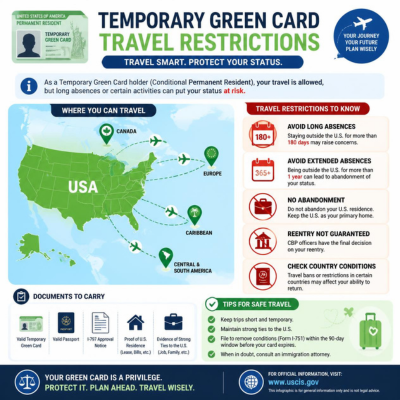
Temporary Green Card Travel Restrictions
If you received your green card through marriage and it’s less than two years old, you’re likely holding what’s officially called a conditional permanent resident card, though most people just call it a “temporary green card.”
It carries the same rights as a standard 10-year green card in almost every practical sense, but its built-in expiration date and the paperwork tied to removing that condition create a few travel considerations that standard green card holders don’t have to think about as carefully.
If you’ve got international travel coming up, here’s a clear, current breakdown of what temporary green card travel restrictions actually look like, what can go wrong, and how to protect your status while you travel.
Yes, you can travel internationally with a conditional (temporary) green card. You have the same fundamental travel rights as any other lawful permanent resident. The key things to manage are: keeping trips under six months whenever possible,
making sure your card and any required documentation stay valid throughout your trip, filing Form I-751 to remove the conditions on your residency during the correct 90-day window before your card expires,
and being prepared for closer questioning at the border than you might expect, especially given how much more aggressively these rules have been enforced at ports of entry in 2026 compared to previous years.

What Makes a Green Card “Temporary” or “Conditional”
A conditional green card is issued when someone gains permanent residency through marriage to a U.S. Rather than issuing a full 10-year card right away, USCIS issues a two-year conditional version.
This isn’t a lesser status — you can work for any employer, travel internationally, live wherever you choose, and access nearly all the same benefits as someone with a standard 10-year card.
The catch is that near the end of those two years, you’re required to file Form I-751, the Petition to Remove Conditions on Residence, to convert your status into a standard, unconditional green card. Miss that window, and your legal status can unravel quickly, which is part of why travel planning around this deadline matters so much.
The 90-Day Filing Window and Why It Matters for Travel
This window is fixed and generally doesn’t bend for travel plans, so if a long trip is going to overlap with that period, it’s worth planning around it rather than hoping it works out.
If you file I-751 before your card expires and it’s still pending when you travel, you’re generally fine to leave and return to the U.S. as long as you carry your USCIS receipt notice along with your expired physical card. That receipt notice typically extends your status and functions as proof of your continued lawful permanent resident status while the petition is processed.
If USCIS schedules an interview or requests additional evidence while you’re abroad, though, you’ll need to be back in the country to respond, so extended travel during a pending I-751 is something to approach carefully.
How Long Can You Travel Before It Becomes a Problem?
The general time thresholds that apply to all green card holders, conditional or not, come down to three rough tiers:
Under six months: Trips in this range are generally considered safe and don’t typically raise questions about whether you’re maintaining your U.S. residency.
Six months to one year: This range creates what’s sometimes described as a “rebuttable presumption” that you may have broken continuous residence, particularly relevant for future naturalization timing. It doesn’t automatically cost you your status, but it does invite more scrutiny, and you should be ready to show strong evidence of your ongoing ties to the U.S. — things like a lease, a job, tax filings, or family connections.
Over one year: At this point, your standard green card generally isn’t considered valid for re-entry on its own. If you know in advance that you’ll be gone longer than a year, applying for a reentry permit (Form I-131) before you leave is the standard way to protect your ability to return.
If you’re already abroad past the one-year mark without having filed for a reentry permit in advance, you’ll typically need to apply for a Returning Resident (SB-1) visa instead, which is a considerably more involved process handled through a U.S. embassy or consulate.
For conditional residents specifically, there’s an added wrinkle: a reentry permit issued to a conditional permanent resident is only valid for two years from issuance, or until the date your I-751 must be filed, whichever comes first. This is shorter than what standard permanent residents get in some cases, so timing the application correctly matters even more if you’re planning an extended absence during your conditional period.
What Documents You Need When You Travel
At a minimum, plan to carry:
- Your valid conditional green card (Form I-551), if it hasn’t expired
- Your USCIS receipt notice, if your I-751 petition is pending and your physical card has expired
- Evidence of your U.S. ties, such as a lease or mortgage statement, pay stubs or an employment letter, and recent tax filings
- If your green card was based on marriage and you’re traveling without your spouse, documentation supporting your ongoing relationship, such as joint bank statements or a shared lease
Failing to carry proof of your status when asked can create unnecessary complications at the border, even when your underlying status is completely valid.
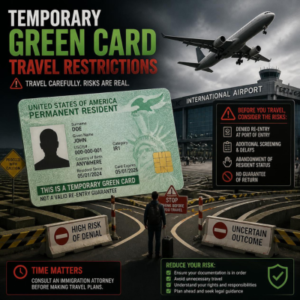
Why 2026 Has Raised the Stakes for Conditional Green Card Holders
The basic legal thresholds around green card travel — the six-month and one-year rules — aren’t new. What has changed significantly in 2026 is how aggressively these rules are being applied and how much additional scrutiny green card holders, conditional and standard alike, now face at ports of entry.
A few developments worth knowing about:
Broader biometric screening. New rules now authorize biometric checks, including photographs and potentially fingerprints, for non-citizens including green card holders at every U.S. border crossing, whether entering or leaving the country. This applies more broadly than before, including to age groups that were previously exempt from this kind of screening.
A significant Supreme Court ruling. In June 2026, the Supreme Court ruled that Customs and Border Protection can treat any returning green card holder as an “applicant for admission” without needing a specific legal exception to do so first.
In practice, this gives CBP considerably more latitude to question, and in some cases detain, returning green card holders, and it has raised particular concern for anyone with any past criminal history, even resolved or minor matters, since criminal court outcomes and immigration consequences are evaluated under very different standards.
Pressure to sign Form I-407. Some returning green card holders, including conditional residents, have reported being pressured by border officers to sign Form I-407, which is a voluntary abandonment of permanent resident status.
This form should never be signed under pressure or without first speaking to an immigration attorney, since it can permanently end your status. You’re entitled to ask for a supervisor and to decline signing anything you don’t fully understand.
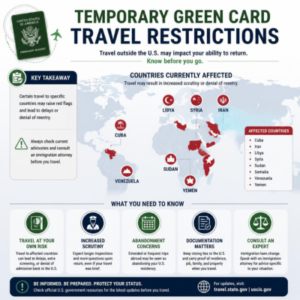
Country-specific flagging. Green card holders and applicants from certain flagged countries are currently facing intensive review, including suspended processing on certain related forms in some cases. If you’re a citizen of one of the countries currently subject to heightened scrutiny, it’s worth checking your specific situation with an immigration attorney before booking international travel.
Given all of this, most immigration attorneys are currently advising a more cautious approach to travel timing than in past years — matching the length and necessity of a trip to your specific risk profile, rather than assuming that older rules of thumb still apply exactly as they used to.
Practical Tips for Traveling on a Conditional Green Card
- Plan trips around your I-751 filing window rather than the other way around, since that 90-day deadline generally doesn’t flex for travel.
- Keep copies of your I-751 receipt notice accessible, both physically and digitally, in case your physical card has expired while the petition is pending.
- Build a folder of U.S. ties evidence before you travel — lease agreements, recent pay stubs, tax returns, school enrollment for children — so you’re not scrambling to gather documents at the border.
- If traveling without your U.S. citizen or permanent resident spouse, bring documentation of your ongoing marriage in case CBP asks questions about the relationship.
- Consider a reentry permit for any trip likely to exceed six months, and apply well before departure, since processing can take time.
- Never sign Form I-407 without speaking to an immigration attorney first, regardless of how much pressure you feel at the border.
- If your case involves a flagged country of origin or any past criminal history, consult an immigration attorney before booking travel, given how significantly enforcement scrutiny has increased in 2026.
The Bottom Line
Holding a conditional, or “temporary,” green card doesn’t prevent you from traveling internationally, and in the vast majority of cases, trips go smoothly. But the built-in complexity of the two-year conditional period, combined with a noticeably tougher enforcement environment in 2026, means it’s worth planning more carefully than you might have in past years.
Keep trips under six months when you can, stay on top of your I-751 filing window, carry solid proof of your U.S. ties, and know your rights if a border officer pressures you regarding your status. When in doubt, especially around longer trips, past criminal history, or country-specific flagging, a conversation with an immigration attorney before you book is almost always worth the peace of mind.
Frequently Asked Questions
Can I travel outside the U.S. with a conditional green card?
Yes. Conditional green card holders have the same fundamental travel rights as standard 10-year green card holders. The main extra consideration is timing trips around your Form I-751 filing window and keeping absences reasonably short.
What happens if my conditional green card expires while I’m traveling?
If you filed Form I-751 before your card expired, your USCIS receipt notice generally extends your status and can be presented along with your expired card at re-entry. If you haven’t filed yet and your card expires while you’re abroad, this can create serious complications, so it’s best to avoid extended travel close to your expiration date.
How long can I stay outside the U.S. on a conditional green card?
Trips under six months are generally considered low-risk. Trips between six months and a year can raise questions about whether you’re maintaining continuous residence, and absences over a year typically require a reentry permit obtained before departure, or a Returning Resident visa if you’re already abroad without one.
Do I need a reentry permit as a conditional green card holder?
If you expect to be outside the U.S. for a year or longer, yes, it’s strongly recommended. Keep in mind that reentry permits for conditional residents are only valid for two years or until your I-751 filing deadline, whichever comes first, which is shorter than the validity period for some standard permanent residents.
Can I be asked to sign Form I-407 at the border?
Some green card holders have reported being pressured to sign Form I-407, a voluntary abandonment of status, during increased scrutiny at ports of entry. You are not required to sign this form on the spot, and doing so can permanently end your permanent resident status. It’s best to decline, request a supervisor if needed, and consult an immigration attorney before signing anything like this.
Does having a criminal record affect travel on a conditional green card?
It can significantly increase risk. Following a 2026 Supreme Court ruling, CBP has broader authority to treat any returning green card holder as seeking admission, and this has been specifically flagged as a heightened concern for anyone with any past criminal conviction, regardless of how the case was resolved. Speaking with an immigration attorney before traveling is strongly advised in this situation.
What documents should I bring when traveling on a conditional green card?
Bring your valid conditional green card or your I-751 receipt notice if your card has expired and the petition is pending, along with evidence of your U.S. ties such as a lease, pay stubs, and tax filings. If traveling without your spouse, documentation of your ongoing marriage can also help avoid unnecessary questioning.