
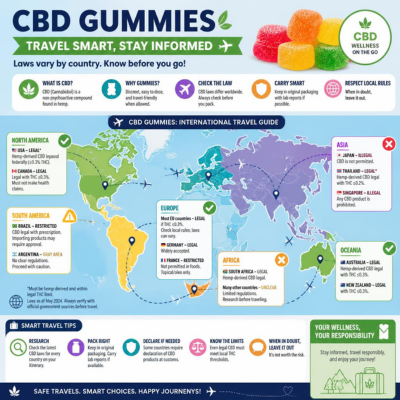
Can You Travel With CBD Gummies Internationally?
CBD gummies have become one of the most popular ways people manage everyday stress, sleep trouble, or travel anxiety, so it’s no surprise that so many travelers want to bring them along on international trips. The tricky part is that the rules that make CBD gummies perfectly legal to buy and carry within the United States don’t automatically apply once you cross a border.
International travel with CBD is a genuinely different situation from flying domestically, and it’s one where good intentions and a compliant U.S. product can still lead to real problems if you’re not careful.
In general, it’s not recommended to travel internationally with CBD gummies, even if the product is fully legal and hemp-derived under U.S. law. The core issue is that most countries don’t share the same legal framework the U.S. uses.
American law draws a bright line at 0.3% THC content to separate legal hemp from illegal marijuana, but plenty of countries either don’t recognize this distinction at all, require a doctor’s prescription for any cannabis-derived product, or ban cannabinoids entirely regardless of THC content.
A product that’s sitting on a pharmacy shelf back home can be treated as a controlled substance the moment it crosses into another country’s jurisdiction.
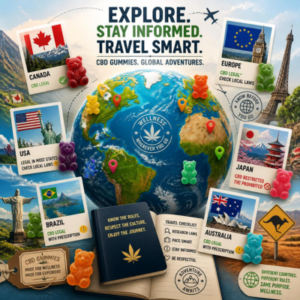
Why International CBD Rules Are So Different From U.S. Rules
In the United States, the 2018 Farm Bill created a fairly clear legal standard: hemp-derived CBD products containing less than 0.3% THC by dry weight are federally legal, and that’s the standard most domestic CBD gummies are built around. This framework doesn’t exist internationally. Each country sets its own rules for cannabis and cannabis-derived compounds, and those rules vary enormously:
- Some countries treat CBD as a legal wellness product with few restrictions, as long as it truly contains no THC.
- Others classify any cannabis-derived product, including CBD, as a controlled substance regardless of THC content, meaning even a completely non-psychoactive gummy could technically be illegal to possess.
- Some require a specific medical prescription or import permit for any cannabinoid product, with no exception for over-the-counter wellness gummies.
- A few have zero-tolerance policies where even trace, non-detectable amounts of THC are treated the same as bringing in marijuana itself.
This means a product can be completely unregulated in your home state and still be classified as a controlled substance the moment you land somewhere else. Worse, U.S. packaging and lab reports don’t carry any legal authority abroad — a Certificate of Analysis showing 0.2% THC is meaningful under U.S. law, but it doesn’t automatically satisfy a foreign country’s much stricter (or entirely different) legal standard.
Where International Customs Officers Differ From TSA
It’s worth understanding how airport and border screening actually works internationally, because it’s meaningfully different from the U.S. domestic experience many CBD users are used to.
Within the U.S., TSA’s screening priority is aviation security — finding weapons and explosives — not hunting for cannabis products. Officers aren’t specifically trained to search for CBD, and hemp products under the legal THC threshold are permitted in carry-on and checked bags.
International customs agencies work differently. Border and customs officers are specifically tasked with enforcing drug import laws, and many are trained to identify cannabis-derived products as part of their core job, not as an incidental discovery.
This means the odds of a CBD product actually being noticed and questioned go up substantially at an international border compared to a domestic TSA checkpoint. Customs agents in many countries also have broader legal authority to search luggage, question travelers directly about the contents of packages, and, in cases involving cannabinoids, escalate the matter far more quickly than a typical TSA referral would.
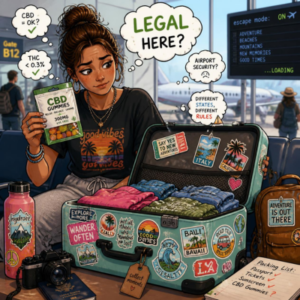
How CBD Gummies Actually Get Detected
There are several ways CBD gummies can be flagged or discovered during international travel, and understanding them helps explain why “it’s just a gummy” isn’t necessarily a safe assumption at customs.
X-ray and scanning technology. Airport security scanners, including the CT scanners increasingly used worldwide, are good at identifying organic material and unusual density patterns inside bags. Gummies packed in bulk, in a branded container, or alongside other supplements can show up clearly enough to draw a closer look, even though the scanner isn’t specifically hunting for cannabis products.
Manual bag searches. If your bag is opened for any reason — a random check, a flagged item, or simply routine inspection — a labeled CBD product becomes immediately visible and readable to the officer. Product labeling that clearly states “CBD,” “hemp extract,” or “cannabidiol” is often exactly what draws attention, since these terms are recognizable red flags in many countries regardless of the actual legal THC content.
Declaration and customs forms. Many countries require travelers to declare certain categories of goods, including supplements, herbal products, or anything derived from a controlled plant. Failing to declare a CBD product that should have been declared can turn a minor issue into a more serious one, since it can be treated as an attempt to conceal a prohibited item rather than an honest mistake.
Drug-detection canine units. A number of international airports use trained detection dogs, and depending on their specific training, some can respond to cannabis-derived scent compounds even in products with very low or no THC, since the dogs are often trained on the broader cannabis plant profile rather than isolated THC molecules specifically.
Random searches at land border crossings. For travelers driving between countries, land border checkpoints often involve secondary inspection at the discretion of the officer, and cannabinoid products found during these checks are handled according to that specific country’s law, which can be considerably stricter than U.S. federal or state standards.
None of these detection methods are foolproof or guaranteed to catch every CBD product a traveler might carry, but the more of these checkpoints a trip involves — connecting flights through multiple countries, land border crossings, thorough customs declarations — the greater the cumulative risk becomes.
The Layover Problem
One detail that trips up a lot of travelers: it’s not just your final destination’s laws that matter. If your itinerary includes a layover or connecting flight through another country, you’re technically subject to that country’s laws during the layover too, even if you never officially leave the airport terminal. A destination with permissive CBD laws doesn’t help if your connection routes through a country with a strict zero-tolerance policy on cannabinoids. This is easy to overlook when booking flights, since layover countries often aren’t top of mind the way a final destination is.
What Can Happen If CBD Is Found
Consequences for carrying CBD internationally vary enormously depending on the country, the product, and the individual officer involved, but they can include:
- The product simply being confiscated with no further consequence
- Additional questioning and delayed processing through customs
- Fines or administrative penalties
- Denial of entry into the country
- In stricter jurisdictions, referral for further legal action, which in a small number of countries can be quite severe
Most travelers who bring CBD gummies internationally never run into a serious problem, largely because most products in small personal-use quantities simply go unnoticed. But “usually fine” isn’t the same as “actually legal,” and the downside risk in the countries with the strictest laws is significant enough that it’s worth taking seriously rather than assuming the odds will always work out.
Practical Tips If You Choose to Travel With CBD Gummies
If, after weighing the risks, you decide to bring CBD gummies on an international trip, a few precautions can help reduce risk, though none of them eliminate it entirely:
- Research your destination’s specific CBD laws in advance, not just general cannabis laws, since some countries distinguish between the two and others don’t.
- Check every country your itinerary touches, including layovers, not just your final stop.
- Choose THC-free, broad-spectrum or isolate products rather than full-spectrum ones, since some countries are more tolerant of products with zero detectable THC.
- Keep products in original, clearly labeled packaging and carry a Certificate of Analysis, even though it won’t carry legal weight everywhere, it can help explain the product if questioned.
- Only carry a small, clearly personal-use quantity, since larger amounts are more likely to raise questions about intent.
- Declare the product if your destination’s customs form asks about supplements or herbal products, rather than risking the appearance of concealment.
- Consider buying a compliant, local product at your destination instead, particularly in countries where CBD is legal to sell but import rules are unclear or restrictive.
Final Thoughts
CBD gummies that are completely legal to buy and carry within the United States don’t automatically translate to being legal, or even low-risk, once you cross an international border. Every country sets its own rules for cannabinoid products, detection methods at international checkpoints tend to be more rigorous than typical U.S. domestic screening, and even layover countries can matter.
For most travelers, the safest and simplest choice is to leave CBD gummies at home for international trips and, where legal, source a local product after arriving. If you do choose to travel with them, researching your specific destination’s laws — and any countries along your route — is the single most important step you can take.
Frequently Asked Questions
Is it illegal to bring CBD gummies on an international flight?
It depends entirely on the countries involved. Some countries allow CBD products freely, others require a prescription, and some ban cannabinoid products of any kind regardless of THC content. There’s no single answer that applies worldwide, which is why researching your specific destination (and any layover countries) matters.
Can airport scanners detect CBD gummies?
Modern scanning technology can identify organic material and unusual packaging inside luggage, which can prompt a closer look even for a legal product. Manual searches, customs declarations, and in some airports, detection dogs can also lead to a CBD product being noticed and questioned.
Does a Certificate of Analysis (COA) protect me at international customs?
Not necessarily. A COA showing low or no THC content is meaningful under U.S. law, but foreign customs agencies aren’t required to recognize U.S. testing standards or documentation. It may help explain your product if questioned, but it doesn’t guarantee it will be treated as legal.
Are CBD gummies treated differently from CBD oil at customs?
Sometimes. Gummies are solid, so they avoid the liquid restrictions that apply to oils and tinctures, which can simplify security screening in some countries. However, this doesn’t change whether the product itself is legal to import, which depends entirely on the destination country’s cannabinoid laws.
What happens if CBD gummies are found during an international layover?
You’re generally subject to the laws of the country you’re passing through during a layover, even if you don’t officially enter the country beyond the airport. If that country has strict cannabinoid laws, a CBD product could cause problems there even if your final destination allows it.
Is it safer to buy CBD gummies at my destination instead of bringing my own?
In most cases, yes, if CBD is legally sold there. Purchasing locally avoids the risks associated with importing a product across a border and ensures whatever you’re using complies with that country’s specific regulations rather than U.S. standards.
Do all countries use the same THC limit as the U.S. for legal CBD?
No. The 0.3% THC threshold is a U.S. federal standard under the 2018 Farm Bill and isn’t universally recognized elsewhere. Some countries have stricter limits, some allow no detectable THC at all, and others don’t distinguish CBD from marijuana in their legal framework.